Why India’s Coworking Boom Could Be the Next Big Investment Opportunity
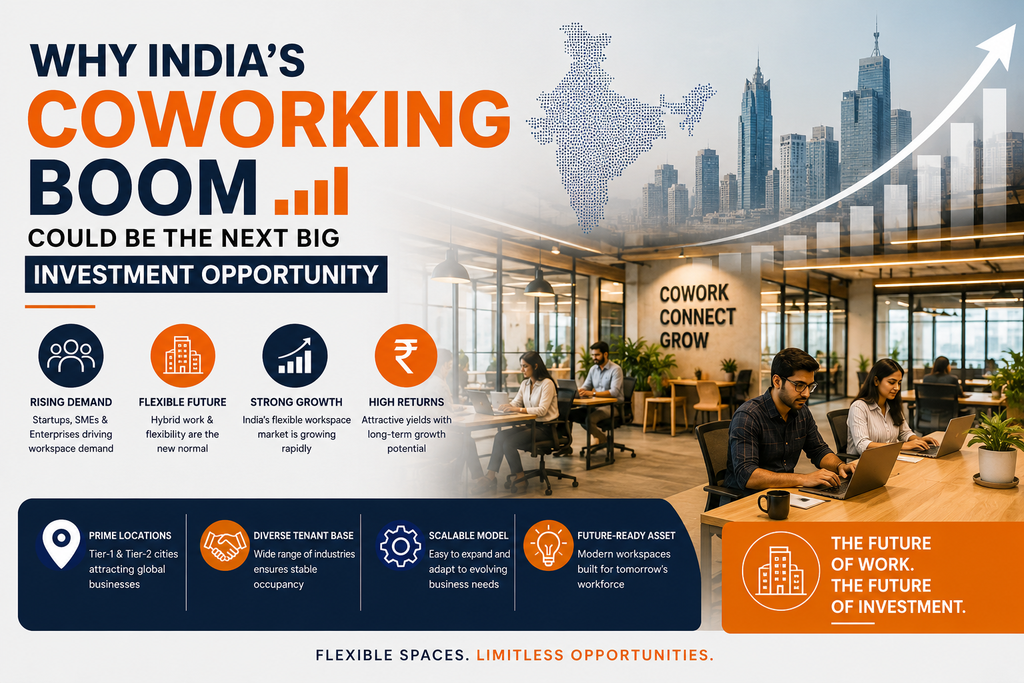
India’s coworking industry has evolved from a niche concept into an important part of the country’s commercial real estate market. As businesses increasingly seek flexibility, scalability, and cost-efficient workplaces, flexible workspaces are becoming a strategic choice for startups, SMEs, large enterprises, and global companies.
The growth of India’s office market provides strong support for this trend. In 2025, India recorded a record 83.3 million sq. ft. of gross office leasing, while flexible workspace operators accounted for 21.5% of annual leasing activity.
Growing Demand for Flexible Workspaces
The traditional office model is changing. Companies no longer want to commit large amounts of capital to long-term office infrastructure when their workforce and business requirements can change quickly.
Coworking spaces offer businesses ready-to-use offices, meeting rooms, high-speed internet, professional facilities, and flexible lease options. This makes them particularly attractive to growing companies that need to increase or reduce their workspace according to business requirements.
CBRE’s 2025 survey found that 72% of occupiers expected to expand their office portfolios by at least 10% over the following two years, while 94% preferred employees to work from the office at least three days a week.
Enterprises Are Driving the Next Phase
Coworking is no longer limited to freelancers and startups. Large corporations and Global Capability Centres (GCCs) are increasingly using flexible workspaces as part of their real estate strategies.
JLL reported that GCCs accounted for 37.7% of India’s gross office leasing activity in 2025, while the flex segment reached a record 26.6% share of leasing in Q4.
This shift creates opportunities for coworking operators and investors who can provide high-quality, enterprise-ready workspaces.
Why Investors Are Paying Attention
The coworking business can offer attractive opportunities because revenue can come from multiple workspace products, including dedicated desks, private cabins, meeting rooms, managed offices, virtual offices, and enterprise solutions.
The sector is also becoming more mature. According to CBRE, India’s flexible workspace ecosystem is moving toward premium locations, better amenities, stronger operational standards, and greater institutional participation.
This indicates that the future opportunity may not simply be about providing desks. It will be about creating professional, technology-enabled, well-connected workplaces that businesses can rely on.
Delhi-NCR and Other Major Markets
Cities such as Bengaluru, Delhi-NCR, Mumbai, Hyderabad, Pune, and Chennai continue to attract strong office demand. Delhi-NCR accounted for 20.9% of India’s gross office leasing in 2025, making it one of the country’s most important commercial markets.
As companies expand into established and emerging business locations, coworking operators with strategically located properties could benefit from increasing demand.
The Road Ahead
India’s coworking boom is being supported by several long-term factors: expanding businesses, GCC growth, hybrid work, rising demand for flexible leases, and companies focusing on operational efficiency.
For investors, this creates an opportunity to participate in a growing segment of commercial real estate. However, success will depend on location, occupancy, pricing, service quality, tenant retention, and efficient operations.
Conclusion
India’s coworking industry is moving beyond the traditional “shared office” model and becoming an important component of modern corporate real estate. With office demand remaining strong and businesses increasingly adopting flexible workspace strategies, coworking could become one of the most promising segments of India’s commercial real estate market.
For investors looking at the future of work, India’s coworking boom may be an opportunity worth watching closely.