How to Register a Private Limited Company in India
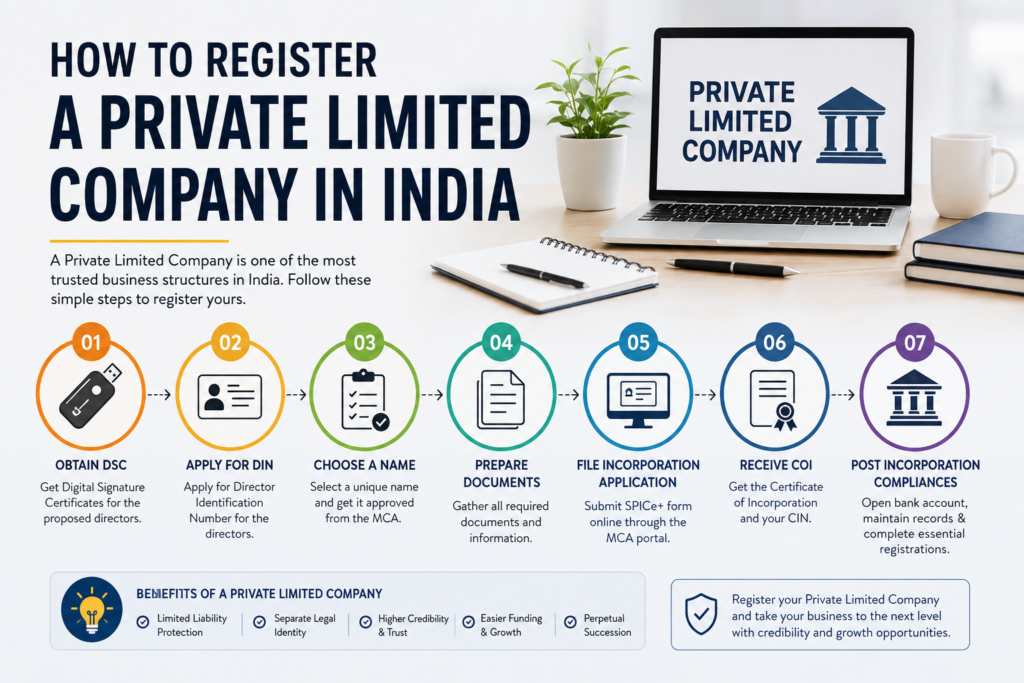
Starting a business in India requires choosing the right legal structure. A Private Limited Company (Pvt Ltd) is one of the most popular choices for startups, growing businesses, and entrepreneurs because it offers limited liability, a separate legal identity, and better opportunities for raising investment.
What Is a Private Limited Company?
A Private Limited Company is a business entity registered under the Companies Act, 2013. It has a separate legal identity from its owners, meaning the company can own assets, enter contracts, and take legal actions in its own name. The liability of shareholders is generally limited to the amount they have invested in the company.
Eligibility for Registration
To register a Private Limited Company in India, you generally need at least two directors and two shareholders. The same individuals can act as both directors and shareholders. At least one director must meet the applicable Indian residency requirement. The company must also have a registered office address in India.
Steps to Register a Private Limited Company
1. Obtain Digital Signature Certificates
Since company registration involves online filing, proposed directors need a Digital Signature Certificate (DSC) to digitally sign forms submitted to the Ministry of Corporate Affairs (MCA).
2. Apply for Director Identification Number
A Director Identification Number (DIN) is required for individuals who will become directors. DIN can generally be applied for through the company incorporation process.
3. Choose a Company Name
Select a unique and appropriate name for your company. The proposed name should comply with MCA naming rules and should not be identical or confusingly similar to an existing company or registered trademark.
4. Prepare Required Documents
Common documents include identity and address proofs of directors and shareholders, photographs, proof of the registered office, and utility bills. Consent and declaration documents may also be required depending on the incorporation process.
5. File the Incorporation Application
The incorporation application is submitted electronically through the MCA portal. The process generally uses the SPICe+ forms, which combine several registration requirements into a streamlined application.
6. Receive the Certificate of Incorporation
After the MCA reviews and approves the application, the company receives a Certificate of Incorporation (COI). The company is then legally registered and receives its Corporate Identity Number (CIN).
7. Complete Post-Incorporation Requirements
After incorporation, the company may need to complete requirements such as opening a corporate bank account, maintaining statutory records, issuing share certificates, and completing applicable tax and other registrations.
Documents Required
Typically, the registration process requires PAN and identity/address proof of directors and shareholders, photographs, registered office proof, and address documents. The exact requirements can vary depending on the circumstances of the company and its proposed directors.
Benefits of a Private Limited Company
A Private Limited Company provides limited liability protection, a separate legal identity, improved credibility, and a structured ownership model. It can also make it easier to bring in investors and expand the business compared with some other business structures.
Conclusion
Registering a Private Limited Company in India involves selecting a suitable name, obtaining required digital signatures, preparing documents, filing incorporation forms with the MCA, and completing post-registration compliances. Entrepreneurs should ensure that all information and documents are accurate and that ongoing statutory requirements are followed. For complex cases, consulting a qualified professional can help ensure a smooth registration process.