Delhi-NCR Sees Rising Demand for Flexible Office Spaces: Why Companies Are Moving Away From Traditional Offices
Delhi-NCR is witnessing a significant transformation in the way businesses think about office space. From startups and growing businesses to large enterprises and multinational companies, organizations are increasingly exploring flexible office spaces, coworking spaces and managed offices instead of committing to traditional long-term office leases.
The shift is being driven by changing workforce requirements, cost pressures, hybrid working models and the need for businesses to scale quickly.
Flexible Workspaces Are Gaining Momentum
The demand for flexible workspaces in Delhi-NCR has grown rapidly in 2026. According to Cushman & Wakefield, Delhi-NCR recorded 21,970 flexible workspace seats leased during H1 2026, representing a 152.7% year-on-year increase.
JLL also reported that flexible operators accounted for 41% of Delhi-NCR’s office leasing in Q2 2026, demonstrating how important flexible workspace has become in the region’s commercial real-estate market.
This growth reflects a broader change: companies are increasingly treating office space as a flexible business service rather than a fixed long-term asset.
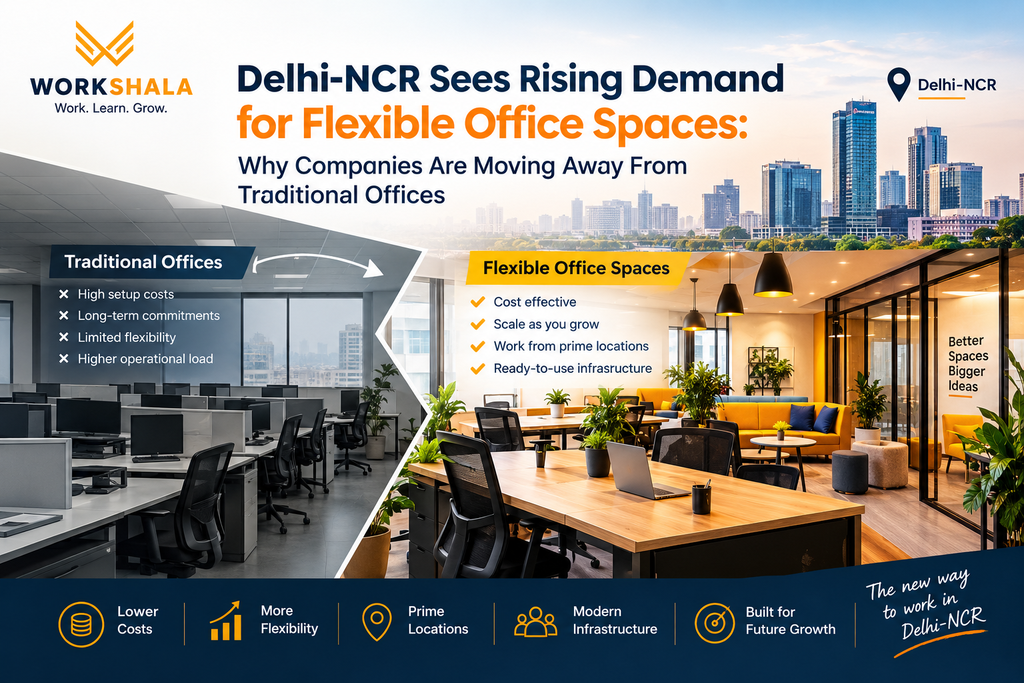
Why Companies Are Moving Away From Traditional Offices
1. Lower Initial Investment
Setting up a conventional office requires significant spending on interiors, furniture, technology, security, utilities and other infrastructure. Flexible offices provide ready-to-use workplaces, allowing businesses to reduce upfront setup costs.
2. Greater Flexibility
Business requirements can change quickly. A company may need 10 seats today and 50 seats within a year. Flexible workspace providers allow businesses to increase or reduce their workspace according to their requirements without completely relocating.
3. Hybrid Work Is Changing Office Requirements
The growth of hybrid and distributed working has changed how employees use offices. Companies no longer necessarily need large permanent workspaces for every employee. Instead, they can use flexible offices for collaboration, meetings, team-building and days when employees work from the office.
4. Prime Business Locations
Location remains important for attracting employees, meeting clients and building a professional image. Flexible workspace providers allow companies to access established commercial hubs such as Gurugram, Noida and Delhi without taking on the full cost and commitment of a traditional office.
5. Ready-to-Use Infrastructure
Modern flexible offices generally provide essentials such as high-speed internet, meeting rooms, reception facilities, workstations and professional office environments. This allows businesses to focus on operations instead of managing every aspect of office infrastructure.
Gurugram and Noida Leading the Change
Gurugram and Noida remain important contributors to Delhi-NCR’s office market. JLL reported that Gurugram accounted for 56% of Delhi-NCR’s net office absorption in Q2 2026, while Noida contributed 30%.
The strong commercial ecosystems, connectivity, talent availability and presence of established businesses continue to make these locations attractive for flexible workspace expansion.
The Future of Office Space in Delhi-NCR
The rise of flexible workspaces does not mean traditional offices will disappear. Instead, businesses are likely to adopt a combination of conventional, coworking and managed-office solutions based on their operational requirements.
For startups, SMEs and expanding enterprises, flexible offices offer an attractive combination of cost efficiency, scalability, convenience and professional infrastructure.
As businesses continue adapting to hybrid work and changing workforce needs, flexible office spaces are expected to become an increasingly important part of Delhi-NCR’s commercial real-estate landscape.
The future of work in Delhi-NCR is not simply about having an office—it is about having the right office, at the right size, in the right location, with the flexibility to grow.